
Build, Don’t Buy: AI Is Reshaping App Store Spending
Measurable AI’s e-receipt data shows in-app purchase volume declining as AI adoption explodes.
At Measurable AI, we track consumer spending through transactional e-receipt data — the actual purchase confirmations that land in people’s inboxes after they buy something on the App Store, subscribe to a service, or make an in-app purchase. It’s one of the most granular, real-time windows into how consumers spend their money on digital products.
According to Measurable AI’s transactional e-receipts data, consumers are making fewer In-App Purchases in the past few years. Looking at Apple App Store in-app purchase (IAP) order volume among US consumers in our panel, the trend from 2021 through mid-2024 was remarkably stable, give or take seasonal fluctuations.
Then it started to slide.
By mid-2025, monthly in-app purchase order volume had declined by roughly 25% compared to the 2021–2023 baseline. By early 2026, the decline had deepened to around 40%.
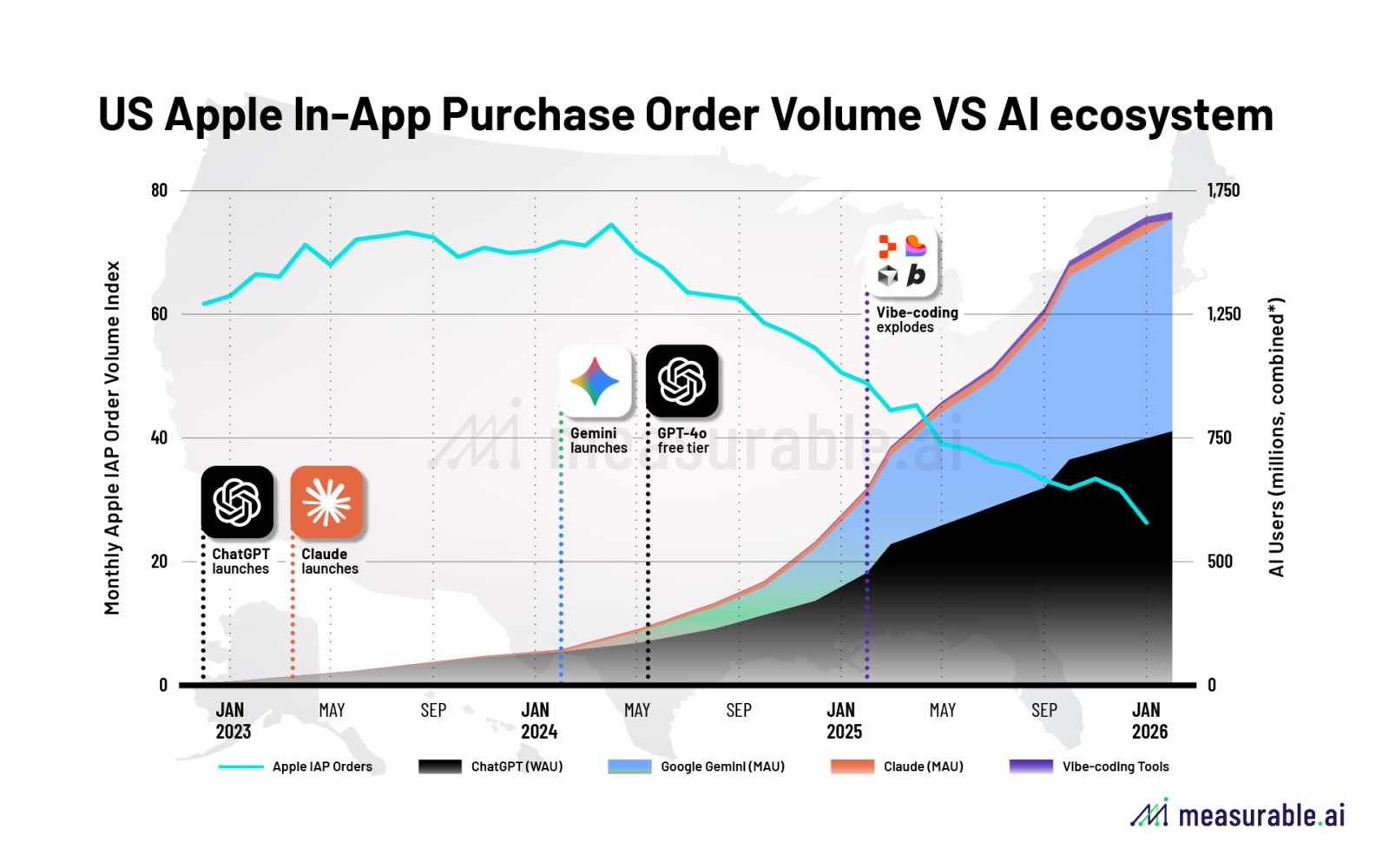
The decline coincides almost perfectly with the explosive growth of AI tools. ChatGPT launched in November 2022, and has since rocketed past 900 million. Google Gemini went from zero to 750 million monthly active users. Claude, Cursor, Lovable, and a wave of other LLMs and AI-powered tools have all reached mainstream adoption in the same window.
But Wait — Isn’t App Revenue at Record Highs?
Apple’s publicly reported data shows overall US App Store consumer spending actually grew 18% year-over-year in 2025, hitting $55.5 billion. But app downloads in the US fell 4.2% in 2025 — the fifth consecutive year of decline. And the revenue growth is increasingly concentrated in subscriptions, particularly AI-powered ones. Generative AI app revenue alone tripled to over $5 billion in 2025, according to Sensor Tower. Strip out the AI category, and traditional app spending looks much flatter.
Our e-receipt data captures this nuance in a way that top-line revenue figures don’t. We’re seeing fewer individual purchase events — consumers are buying less frequently — even as the average order value creeps up. The average order value for Apple IAP is the US has increased from ~$10.59 to ~$16.86 between 2021–2023 and early 2026 — a 59% jump — even as order volume dropped 40% over the same period. Fewer $4.99 impulse buys on utility apps. More $20/month recurring subscriptions for ChatGPT, Claude, and Cursor.
The app economy is restructuring.
The Vibe-Coding Effect: Why Buy When You Can… Build?
When Andrej Karpathy coined the term “vibe coding” in early 2025, he was describing something that was already happening: people building functional software by describing what they wanted in natural language, letting AI handle the actual code. No programming skills required. Just vibes.
The numbers behind this movement are staggering.
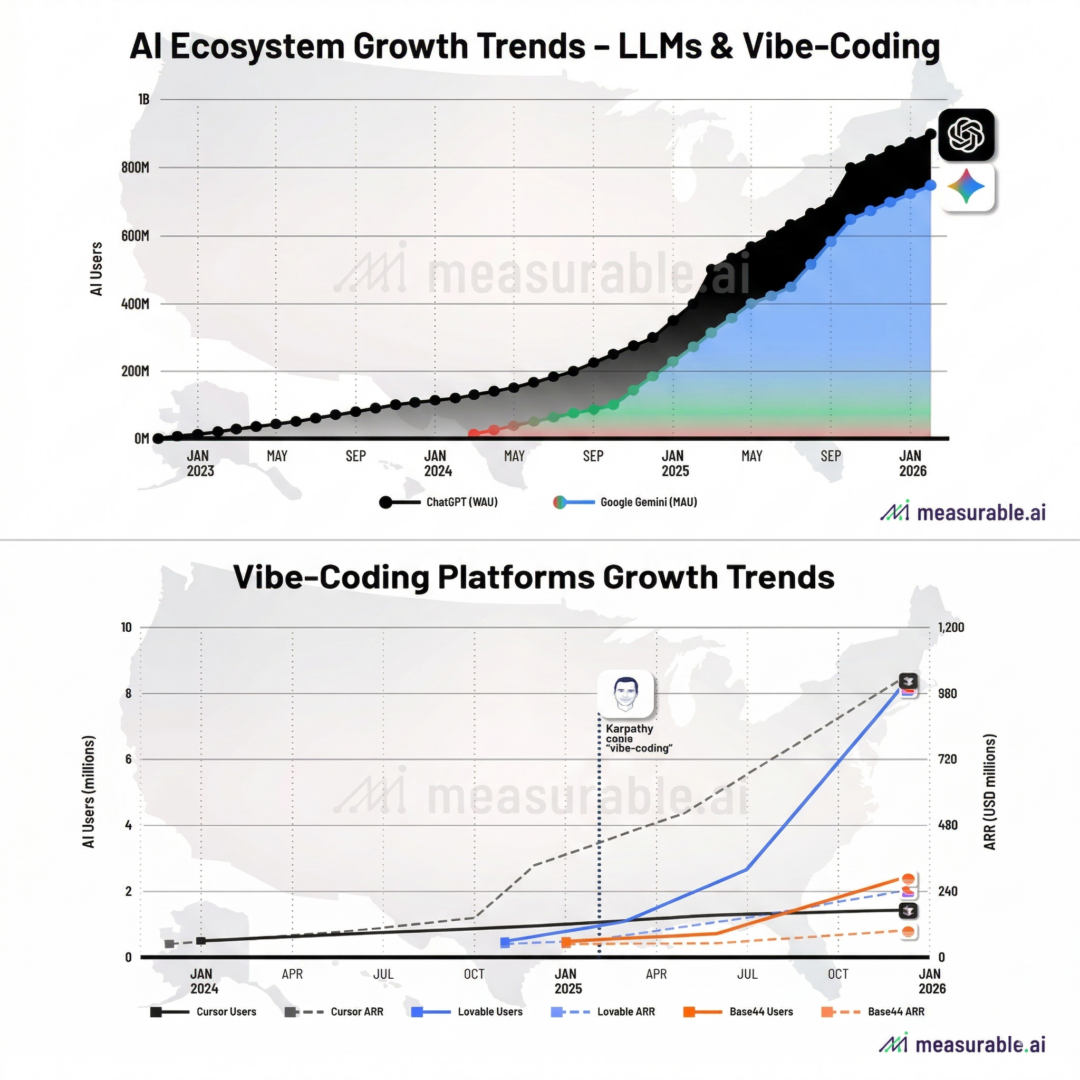
Lovable launched in November 2024 and hit 8 million users within a year. Cursor reached $1 billion ARR in 2025 — the fastest any SaaS product has hit that milestone. And Claude Code went from research preview to a $2.5 billion annualized run-rate in under a year.
Tools like Lovable and Base44 are explicitly designed for non-technical users — marketers building landing pages, small business owners creating inventory trackers, students spinning up study tools. These are the same people who used to solve those problems by searching the App Store for a $4.99 app.
Why pay for a generic habit tracker when you can describe exactly how you want one to work and have it built in minutes? Why buy a $9.99 recipe organizer when Claude Code can build one that matches your specific dietary restrictions and evolve the features along the way?
The value proposition of pre-built apps was always convenience — saving you from having to build it yourself. But when building it yourself becomes easier than finding the right app in a sea of App Store listings…
Consumers are quietly spending differently:
The transaction is moving upstream — from buying finished products to buying the tools that let you create your own. A monthly AI subscription replaces dozens of potential individual app purchases. The most downloaded app of the future might be the one that lets you never download another app again. Keep track of this shift with data, at Measurable AI.
A Note on Our Data
One thing we’ve learned building Measurable AI is that transactional e-receipt data captures behavioral shifts that traditional market research misses. E-receipts tell you what individuals actually did, transaction by transaction, in real time.
This kind of granular consumer intelligence is increasingly valuable now for both companies and investors tracking product performance and competitive dynamics — Want to know how ChatGPT Plus subscriptions are trending against Claude Pro? Our data can show you.
Thanks to LLMs the real world data gets more valuable now. As AI becomes more capable of reasoning about markets, consumer behavior, and economic trends, the quality of data they can access becomes a differentiator. Real-world transactional data — anonymized, aggregated, and structured — is the kind of grounding that turns traditional business insights into one that can make genuinely useful predictions about where consumer spending is headed.
Interested in exploring the underlying datasets — for investment research, competitive intelligence, or AI training? Get in touch.
About Measurable AI
Charlie Sheng is a serial entrepreneur, and a dedicated communicator for technology. She enjoys writing stories with Measurable AI’s very own e-receipts data. You can reach her at [email protected].
*The content is for informational purposes only, you should not construe any such information or other material as investment advice. Prior written consent is NEEDED for any form of republication, modification, repost or distribution of the contents.
Check out our annual reports: 2024 AltAsia Online Delivery Report, 2019-2022 Food Delivery Annual Report for Asia, Asia & Americas Ride-hailing Report 2019-2023.
